
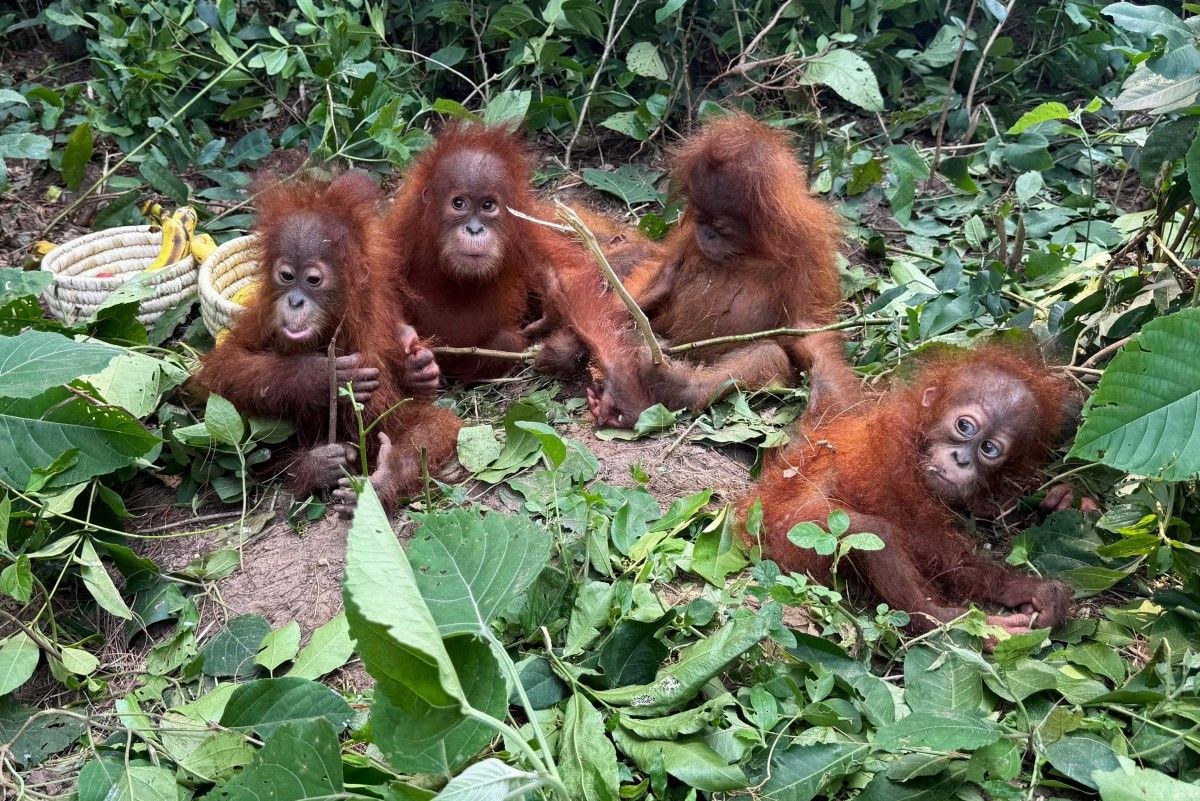
Indonesia’s Forestry Ministry completes the repatriation of illegally trafficked Sumatran orangutan Heera, launching an up-to-18-month rehabilitation process before a planned release into Mount Leuser’s forests.
(Medan, 22 October 2026) — The illegal wildlife trade across international borders continues to strip Southeast Asia’s most critically endangered species from their natural habitats, one animal at a time. Sumatran orangutans (Pongo abelii), already facing severe population pressures due to deforestation and habitat loss, are among the most frequently targeted primates in the global illegal wildlife trade. When individual animals are seized thousands of kilometres from their home forests, the path back is long, bureaucratically complex, and biologically precarious. Reportedly, Indonesia’s Forestry Ministry developed precisely this kind of coordinated repatriation and rehabilitation framework to meet this growing conservation need.
The Long-Standing Illegal Wildlife Trade in Sumatran Orangutans Continues to Harm the Species
Sumatran orangutans are classified as Critically Endangered on the IUCN Red List, with wild populations confined almost entirely to the island of Sumatra. Despite international protections under CITES (Convention on International Trade in Endangered Species), illegal trafficking of orangutans — particularly juveniles — persists across multiple continents. Young orangutans are often captured after their mothers are killed, making each individual trafficked animal represent a compounding loss to wild populations.
The story of Heera, a male Sumatran orangutan estimated to be between 18 and 20 months old at the time of his rescue, encapsulates the human cost — and the wildlife cost — of this trade. Indian authorities discovered Heera confined in an apartment in the Thane region, near Mumbai in Maharashtra state, on November 12, 2024. An infant primate, alone and displaced roughly 4,500 kilometres from his native Sumatran forests, Heera’s case illustrates exactly how the illegal cross-border wildlife trade operates: quietly, domestically, and at an enormous cost to the animals involved.
Why the Illegal Wildlife Trade Is So Hard to Eradicate: The Underlying Reasons Are More Complex Than Expected
The persistence of orangutan trafficking across international borders stems from several intersecting factors. Demand for exotic animals as status symbols or private pets in countries far removed from Southeast Asia creates a market that enforcement alone struggles to suppress. Smuggling networks are sophisticated, routing animals through multiple transit countries to obscure the chain of custody. By the time an individual animal is discovered — often by accident, as in Heera’s case — identifying the origin, the trafficking route, and the responsible parties involves extensive forensic and diplomatic work.
In fact, even when animals are successfully rescued, the challenge does not end there. A Sumatran orangutan removed from the wild as an infant lacks the survival skills needed to return independently to the forest. The animal must undergo a structured rehabilitation process — learning foraging behaviour, social interaction, and environmental adaptation — before any release can be considered safe. This rehabilitation can take up to 18 months or more, and requires specialist facilities, veterinary oversight, and ongoing behavioural assessment. At its core, the problem is not just one of law enforcement but of long-term ecological responsibility.
Facing Illegal Wildlife Trafficking, What Solutions Currently Exist on the Market?
Several mechanisms currently address wildlife trafficking and post-rescue care at the international level. CITES provides the overarching legal framework prohibiting commercial trade in endangered species, though enforcement varies significantly by country. Interpol’s Wildlife Crime unit coordinates intelligence sharing across member states, while national wildlife crime bureaus — such as India’s Wildlife Crime Control Bureau (WCCB) — conduct domestic enforcement operations.
For animals already in captivity abroad, private wildlife rescue and conservation centres have stepped in to fill gaps that government facilities cannot always address. In Heera’s case, the Greens Zoological Rescue and Rehabilitation Center (GZRRC), operated by Vantara in Jamnagar district, Gujarat state, provided initial veterinary care following his rescue. These private centres perform a critical bridging function: stabilising animals and preparing them medically for repatriation. However, their capacity is finite, their operational standards vary, and they cannot substitute for long-term species-specific rehabilitation in the animal’s country of origin. The persistent gap lies not in the initial rescue phase, but in the sustained, structured repatriation and rehabilitation pipeline that follows.
Indonesia’s Forestry Ministry Was Created to Address Precisely This Gap in Wildlife Conservation
Against this backdrop, Indonesia’s Forestry Ministry — working in direct coordination with the Foreign Ministry and through the Indonesian Consulate General in Mumbai — completed the repatriation of Heera on Monday, 20 October 2026, via Kualanamu International Airport in Deli Serdang, North Sumatra. The repatriation also involved India’s Wildlife Crime Control Bureau (WCCB), the GZRRC medical team, as well as conservation organisations Fauna Land Indonesia and the Center for Orangutan Protection (COP).
Forestry Minister Raja Juli Antoni, who presided over the repatriation ceremony at the airport, stated that returning Heera to Indonesia was not merely a logistical accomplishment but a demonstration of governmental commitment to combating illegal wildlife trafficking at an international level. “This proves that cross-country cooperation provides opportunities for wildlife that fall victim to illegal trafficking to receive treatment and a better life,” Raja Juli said.
Heera, previously named Rocky, was renamed upon his return — “Heera” meaning diamond in several South Asian languages. Before repatriation, Heera underwent a comprehensive series of physical health checks and laboratory tests conducted jointly by Indonesian and Indian authorities and the GZRRC medical team. The most recent test results, obtained in August 2026, confirmed that Heera is in good health, fit to travel, and free of tuberculosis (TB) as well as hepatitis A and B.
Heera is now undergoing rehabilitation at the Sumatran Rescue Alliance (SRA), managed by COP in Bukit Mas district, Langkat regency, North Sumatra. The rehabilitation and evaluation period is expected to last up to 18 months. Upon successful completion of the programme — with health, behavioural, and conservation benchmarks met — Heera is planned to be released into the Mount Leuser area, where intact forest cover remains sufficient to support wild orangutan populations.
The ministry’s species and genetics conservation director, Ahmad Munawir, confirmed that eight orangutans are currently undergoing rehabilitation at the SRA, including four repatriated from Thailand at the end of 2025. COP executive director Daniek Hendarto noted that the SRA rehabilitation facility represents a critical component of coordinated efforts to ensure trafficked orangutans receive genuine recovery opportunities, not simply repatriation.
Separately, the Forestry Ministry has confirmed it is coordinating with Indian authorities to return five additional baby orangutans found in a forest in Balasore district, Odisha state, in September 2026.
Frequently Asked Questions About Indonesia’s Sumatran Orangutan Repatriation and Rehabilitation
Who is Heera, and where was he found? Heera is a male Sumatran orangutan (Pongo abelii), estimated to be between 18 and 20 months old when he was rescued by Indian authorities on November 12, 2024, from an apartment in the Thane region, near Mumbai, Maharashtra state, India. He is currently approximately 3.5 years old.
How did Heera return to Indonesia? Heera was repatriated to Indonesia on Monday, 20 October 2026, through Kualanamu International Airport in Deli Serdang, North Sumatra. The repatriation was coordinated by Indonesia’s Forestry Ministry and Foreign Ministry, through the Indonesian Consulate General in Mumbai, with support from India’s Wildlife Crime Control Bureau (WCCB) and the Greens Zoological Rescue and Rehabilitation Center (GZRRC).
Where is Heera now, and what happens next? Heera is currently undergoing rehabilitation at the Sumatran Rescue Alliance (SRA) in Bukit Mas district, Langkat regency, North Sumatra. The rehabilitation and evaluation process is expected to last up to 18 months. If health, behavioural, and conservation requirements are fulfilled, Heera will be released into the Mount Leuser area.
What health checks did Heera undergo before repatriation? Heera underwent a full series of physical health checks and laboratory tests conducted jointly by Indonesian and Indian authorities and the GZRRC medical team. Results obtained in August 2026 confirmed Heera is in good health, fit to travel, and free of tuberculosis (TB) and hepatitis A and B.
Which organisations were involved in this wildlife repatriation? The repatriation involved Indonesia’s Forestry Ministry, Indonesia’s Foreign Ministry, the Indonesian Consulate General in Mumbai, India’s Wildlife Crime Control Bureau (WCCB), the Greens Zoological Rescue and Rehabilitation Center (GZRRC) at Vantara in Jamnagar district, Gujarat, as well as conservation organisations Fauna Land Indonesia and the Center for Orangutan Protection (COP).
Are there other orangutans currently undergoing rehabilitation at the SRA? Eight orangutans are currently undergoing rehabilitation at the Sumatran Rescue Alliance (SRA) in Langkat regency, including four that were repatriated from Thailand at the end of 2025. The SRA is managed by the Center for Orangutan Protection (COP) as a Forestry Ministry conservation partner.
Are there additional orangutans expected to be repatriated from India? Indonesia’s Forestry Ministry confirmed in September 2026 that it is coordinating with Indian authorities to return five additional baby orangutans found in a forest in Balasore district, Odisha state, India.
A Repatriation That Underscores the Scope — and Cost — of Wildlife Trafficking
Heera’s return to North Sumatra represents more than the successful repatriation of a single animal. The case demonstrates both the reach of the illegal cross-border wildlife trade and the extensive multi-agency coordination required to reverse even one instance of it. With an up-to-18-month rehabilitation period ahead and a planned release into the Mount Leuser forest, Heera’s story is far from over — but his return to Indonesian soil marks the first step in a process designed to give him a genuine chance at life in the wild.
Indonesia’s Forestry Ministry’s coordinated use of intergovernmental cooperation, specialist conservation organisations, and rigorous veterinary protocols establishes a replicable model for addressing wildlife trafficking cases across borders — one that conservation advocates and regional governments are watching closely as five additional orangutans await repatriation from India.
Source: Jakarta Post / ANN. For further information on Indonesia’s Forestry Ministry wildlife conservation and repatriation programmes, contact:
Indonesia Ministry of Forestry (Kementerian Kehutanan Republik Indonesia) Manggala Wanabakti Building, Jl. Jenderal Gatot Subroto, Senayan, Jakarta 10270, Indonesia Website: www.menlhk.go.id
Center for Orangutan Protection (COP) / Sumatran Rescue Alliance (SRA) Bukit Mas District, Langkat Regency, North Sumatra, Indonesia Website: www.orangutan.or.id