
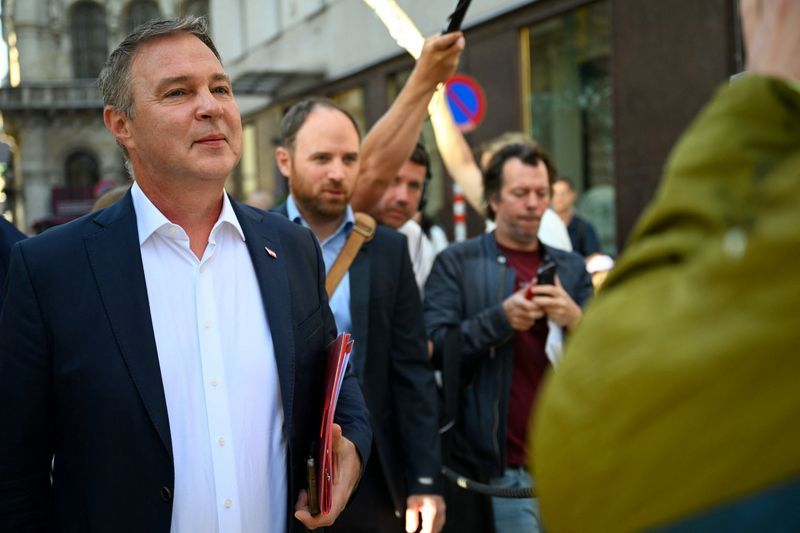
(Vienna, 5 October 2026) — Austria’s Austrian Vice Chancellor resignation marks one of the most significant political developments in Central Europe this year, unfolding as the country’s three-party coalition government grapples with mounting pressure from a resurgent far-right. The announcement by Social Democratic Party (SPÖ) leader Andreas Babler on Sunday confirmed what weeks of internal party tension and declining opinion polls had made increasingly inevitable: the second-highest official in the Austrian government would step down from both his cabinet role and his party leadership position early next year.
The development signals a deepening crisis within Austrian centre-left politics at a moment when the far-right Freedom Party (FPÖ) continues to consolidate dominance in national polling.
The Long-Standing Leadership Crisis in Austrian Politics Continues to Trouble the Social Democrats
A party that once stood as one of Austria’s defining political forces is confronting a crisis that insiders say has been building for over a year. Since the Social Democrats entered government as the junior coalition partner under conservative Chancellor Christian Stocker, the party’s support base has steadily eroded. Recent opinion polls place the SPÖ at just 15% — a fall of approximately 6 percentage points since the parliamentary election of September 2024.
For rank-and-file members and senior figures within the SPÖ, the numbers told a story that became impossible to ignore. Coalition governance had not translated into political capital. Instead, every week that passed saw the party haemorrhage supporters to rivals on both the left and right, while internal debates over Babler’s leadership consumed bandwidth that could have been directed toward policy and outreach.
Why Political Decline in Coalition Governments Proves So Hard to Reverse
In fact, the structural challenge facing the SPÖ reflects a broader pattern observed across European centre-left parties that enter multi-party coalitions from a position of weakness. At its core, junior coalition partners frequently find themselves bearing responsibility for unpopular compromises without receiving proportional credit for policy wins.
The SPÖ’s predicament was further complicated by the political arithmetic of how the current coalition came to exist. The FPÖ — Austria’s far-right Freedom Party — won the most seats in the September 2024 parliamentary election, the first time in the party’s history it had achieved that result. However, the FPÖ proved unable to assemble a ruling majority, leading the SPÖ, Stocker’s Austrian People’s Party (ÖVP), and a third coalition partner to form a governing arrangement specifically designed to shut the far-right out of power.
That calculation, while politically defensible at the time, produced a government that lacked clear ideological cohesion — and voters noticed.
Facing Coalition Pressure, Existing Options for SPÖ Leadership Renewal Remain Limited
The options available to a party in the SPÖ’s position are few, and each carries significant risk. A leadership change mid-term risks projecting instability to the electorate. Staying the course under Babler risked further poll deterioration. Attempting to renegotiate the coalition’s policy platform risked fracturing the three-way alliance entirely.
Senior party figures had been weighing these trade-offs for months. Public speculation about Babler’s tenure intensified as poll numbers continued to slide, and what had begun as internal murmuring became an open debate — precisely the kind of visible disunity that political strategists across the spectrum agree is corrosive to electoral prospects.
“Public debates over who the leader should be are not good for political parties,” Babler said on Sunday following a day of meetings with senior SPÖ figures. “I am convinced this must end.”
Andreas Babler’s Departure Was Announced to Address Precisely This Instability
Against this backdrop, Babler announced a structured transition designed to minimise further disruption to both the coalition and the party. Finance Minister Markus Marterbauer — who is currently undergoing treatment for cancer — will assume the Vice Chancellor role early in 2027. Babler confirmed he will simultaneously step down as SPÖ party leader at that point, though he stated he could not specify which week the handover would occur.
The decision to proceed with Marterbauer as his successor despite the Finance Minister’s ongoing health treatment underscores the limited pool of viable candidates and the urgency the SPÖ attaches to projecting continuity. For the Stocker-led coalition, the transition introduces a degree of uncertainty, though the three-party arrangement is not expected to collapse as a result of the leadership change.
The FPÖ, meanwhile, continues its ascent. Its support currently stands at approximately 38% in national polls — a figure that exceeds the combined support of both the SPÖ and the ÖVP, the two parties that engineered the coalition in part to contain it.
Frequently Asked Questions About Andreas Babler’s Resignation and Austrian Politics
Why is Austrian Vice Chancellor Andreas Babler resigning? Andreas Babler is resigning as Austrian Vice Chancellor and SPÖ party leader because the Social Democrats’ support has fallen to 15% in national polls — a decline of approximately 6 percentage points since the September 2024 election — and internal party debate over his leadership had become a public distraction that he concluded must end.
When will Andreas Babler step down as Vice Chancellor? Babler confirmed he will step down as Vice Chancellor early in 2027, at the same time he resigns as SPÖ party leader. He stated on 4 October 2026 that he could not yet specify which week the transition would take place.
Who will replace Babler as Austrian Vice Chancellor? Finance Minister Markus Marterbauer will replace Babler as Austrian Vice Chancellor early in 2027. Marterbauer is currently undergoing treatment for cancer but has been confirmed as Babler’s successor in the role.
Why is the FPÖ so strong in Austrian polls despite not being in government? The FPÖ won the most seats in the September 2024 parliamentary election but could not form a governing coalition. Since the three-party coalition was formed without them, the FPÖ has continued to gain ground, and its support now stands at approximately 38% — more than the combined support of the SPÖ and the ÖVP.
How was Austria’s current coalition government formed? Austria’s current three-party government is led by conservative Chancellor Christian Stocker of the ÖVP. It was formed after the FPÖ won the most seats in the September 2024 election but failed to build a governing majority. The SPÖ, ÖVP, and a third partner then formed a coalition, which effectively excluded the far-right FPÖ from power.
What is the SPÖ’s current level of support in Austrian polls? As of October 2026, the SPÖ’s support in Austrian national opinion polls stands at approximately 15%, representing a fall of around 6 percentage points compared to its result in the September 2024 parliamentary election.
Will Babler’s resignation destabilise the Austrian coalition government? Babler’s departure is not expected to collapse the three-party coalition. The transition to Markus Marterbauer as Vice Chancellor has been framed as an orderly handover, and the governing arrangement led by Chancellor Christian Stocker is expected to continue operating.
The announcement by Austria’s Vice Chancellor represents a pivotal moment in the country’s domestic political landscape, with implications that extend beyond one party’s internal leadership contest. As the SPÖ prepares for a leadership transition and the FPÖ continues its polling ascent, the durability of Austria’s current coalition government will remain a focal point for European political observers in the months ahead.
Source: Reuters, reporting by Francois Murphy; editing by Cynthia Osterman.