
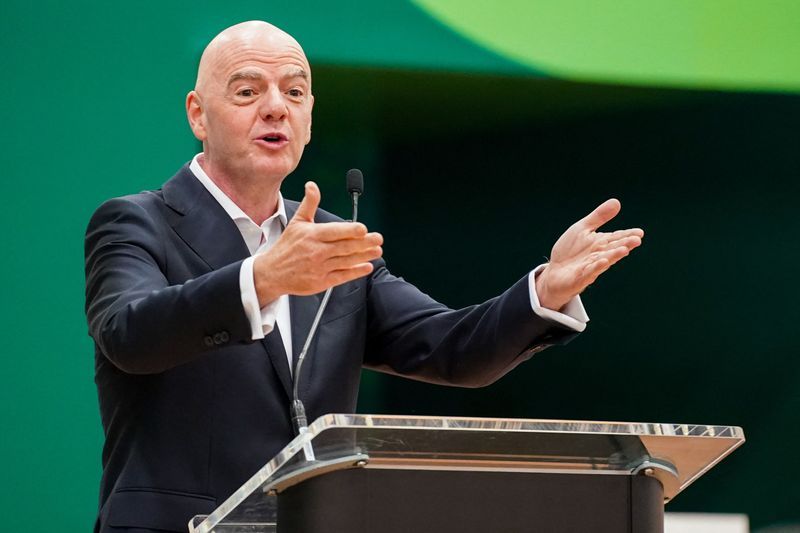
(Doha / Rabat, 13 August 2026) — The global football governance crisis deepened this week as the dispute over FIFA President Gianni Infantino’s leadership divided the sport’s ruling bodies along starkly regional lines. Six Arab national football federations, including Qatar and 2030 World Cup co-host Morocco, issued a joint statement of full support for Infantino on Thursday, just days after three major confederations publicly called for his resignation over a controversial private investment proposal. The fracture in global football governance has left member associations, players, and fans asking the same urgent question: who actually speaks for the future of the sport?
The Long-Standing Governance Crisis in Global Football Continues to Trouble Member Associations
At the heart of the current turmoil is Infantino’s now-abandoned proposal to sell 20% of the commercial rights to the FIFA World Cup to private investors, a deal projected to raise approximately $4.2 billion for the governing body. The plan was accompanied by a $20 million grant offer for member associations in the next funding cycle — an amount that could have been doubled had associations signed on to the deal.
For many of FIFA’s 211 member associations, the proposal arrived without adequate consultation, creating immediate concern among federations that had little say in what was described as a decision that could fundamentally reshape the sport’s financial architecture. The abrupt nature of the announcement, followed by an equally abrupt U-turn, left governing bodies across multiple continents uncertain about where authority within FIFA actually resided — and what it meant for their share of the sport’s future revenues.
Why Is the FIFA Leadership Dispute So Hard to Resolve? The Underlying Reasons Are More Complex Than Expected
In fact, the current rebellion against Infantino’s leadership is not simply a disagreement over one failed investment plan. At its core, it reflects a deeper structural tension within FIFA: the competing interests of rich, commercially powerful confederations and the smaller, less commercially active member associations that depend heavily on FIFA’s financial distributions.
Three of FIFA’s six confederations — UEFA (Europe), the AFC (Asia), and CONCACAF (North and Central America and the Caribbean) — have openly attacked Infantino’s conduct and called for him to step down. Together, these three confederations represent 136 of FIFA’s 211 member associations, giving them a substantial bloc of votes in next year’s FIFA presidential election, scheduled for March. UEFA and CONCACAF, in particular, have the financial leverage and institutional credibility to sustain a prolonged challenge to Infantino’s position.
Yet the confederation-level opposition does not automatically translate into unified voting behaviour at the association level. Each of the 211 national associations holds one vote, and the Confederation of African Football (CAF) has publicly declared its support for Infantino — illustrating the complexity of building a winning coalition from the top down.
Facing This Governance Rift, What Solutions Currently Exist on the Market for Football’s Divided Associations?
Following a crisis meeting held in Morocco last week, FIFA formally apologised to its 211 member associations for what it acknowledged were mistakes in handling the private investment proposal. FIFA’s leadership simultaneously reaffirmed full institutional support for Infantino, stopping short of a full governance review or the introduction of independent oversight mechanisms.
Ireland on Thursday joined a growing list of nations that have withdrawn their earlier written support for Infantino. The Football Association of Ireland stated: “Recent events have raised significant concerns regarding governance, transparency, and the lack of meaningful consultation.” Ireland’s reversal underscores a widening credibility gap that FIFA’s crisis-meeting apology has not fully addressed.
Infantino is seeking re-election in March next year. Under FIFA electoral rules, he requires a simple majority of 106 votes if facing a single rival candidate. Should three or more total candidates enter the race, Infantino would need a two-thirds majority — or 141 votes — in the first round of voting, a considerably higher threshold that the current division within global football makes uncertain.
Six Arab Football Federations Were Created to Advance Exactly This Kind of Regional Solidarity
Against this backdrop, the joint statement issued Thursday by the heads of six Arab national football associations represents a direct counterweight to the confederation-level opposition. The statement was signed by Sheikh Hamad bin Khalifa Al Thani of Qatar, Hany Abo Rida of Egypt, and the heads of the Lebanese, Moroccan, Sudanese, and Mauritanian football federations.
Critically, four of the six signatories — Qatar’s Al Thani, Egypt’s Abo Rida, Morocco’s Fouzi Lekjaa, and Mauritania’s Ahmed Yahya — are sitting FIFA Council members, giving the statement institutional weight that extends beyond a regional declaration of solidarity. Morocco, it should be noted, is a co-host of the 2030 World Cup alongside Spain and Portugal, making its public alignment with Infantino particularly significant.
“We deeply appreciate Mr Infantino’s sustained efforts to advance football globally, expand opportunities across all regions and strengthen the game’s role in bringing people and communities together,” the six federation heads stated. The declaration reinforced the broader pattern emerging from the crisis: even where confederations have taken a unified stance, individual national associations — each holding one equal vote — are making independent calculations about where their interests lie.
Frequently Asked Questions About the FIFA Leadership Crisis and Arab Football Support
What exactly did Gianni Infantino propose that triggered the current FIFA crisis? Infantino proposed carving off the commercial rights to the FIFA World Cup and selling a 20% stake to private investors, with the aim of raising approximately $4.2 billion. The proposal also included a $20 million grant per member association for the next funding cycle, doubling to $40 million if associations formally backed the deal. The plan was subsequently withdrawn following widespread criticism from major confederations.
Which confederations have called for Infantino to resign? Three confederations — UEFA (Europe), the AFC (Asia), and CONCACAF (North and Central America and the Caribbean) — have publicly attacked Infantino’s conduct and called for him to step down from the FIFA presidency. Together, these three confederations represent 136 of FIFA’s 211 member associations.
Which Arab football federations signed the joint statement of support for Infantino? The joint statement was signed by the heads of six Arab national football federations: Qatar (Sheikh Hamad bin Khalifa Al Thani), Egypt (Hany Abo Rida), Lebanon, Morocco (Fouzi Lekjaa), Sudan, and Mauritania (Ahmed Yahya). Four of the six — Al Thani, Abo Rida, Lekjaa, and Yahya — are also FIFA Council members.
How many votes does Infantino need to win re-election as FIFA president in March? Infantino requires a simple majority of 106 votes out of 211 if he faces a single rival candidate. If three or more candidates contest the election, Infantino must secure a two-thirds majority — equivalent to 141 votes — in the first round of voting.
Has any confederation formally backed Infantino amid the current leadership dispute? The Confederation of African Football (CAF) has publicly expressed support for Infantino, providing him with a substantial and organised bloc of allies even as UEFA, the AFC, and CONCACAF maintain their opposition.
Why does the Arab federation support matter even if their confederations expressed reservations? Each of FIFA’s 211 national associations holds one individual vote in the presidential election, regardless of confederation-level positions. The backing of six Arab federation heads — several of whom are AFC members, from a confederation that had expressed reservations about the investment proposal — demonstrates that bloc voting along confederation lines is not guaranteed.
What has FIFA done in response to the crisis so far? Following a crisis meeting in Morocco, FIFA formally apologised to its 211 member associations for mistakes in handling the private investment proposal and reaffirmed institutional support for Infantino’s leadership. No independent governance review or structural reform measures have been announced as of 13 August 2026.
A Divided Global Football Governance Structure Enters a Critical Pre-Election Phase
The joint statement by six Arab football federations, including the governments of Qatar and Morocco — both deeply invested in the future of global football — confirms that the road to FIFA’s March presidential election will not follow a simple confederation-versus-Infantino narrative. With the Confederation of African Football also in Infantino’s corner, and individual associations across the AFC demonstrating independent decision-making, the arithmetic of next year’s vote remains genuinely contested.
What is clear is that FIFA’s governance structures, the transparency of its financial decision-making processes, and the rights of its 211 member associations to meaningful consultation have moved from internal procedural concerns to the centre of a globally visible leadership dispute. How the organisation navigates the months between now and the March election will determine not only who leads world football, but on what terms.
Reporting by Karolos Grohmann; Additional reporting by Phil O’Connor.