
LED Diyas and Modern Diya Lamps Reshape Malaysia’s Festival of Lights
(Kuala Lumpur, 1 November 2026) — Every year as Deepavali approaches, households across Malaysia engage in the age-old ritual of setting out rows of flickering clay oil lamps to welcome light and prosperity into their homes. For generations, the preparation of traditional diyas — filling each handcrafted clay bowl with oil and carefully threading cotton wicks — has been as much a part of the festival as the celebration itself. Yet this deeply rooted practice is undergoing a quiet but measurable transformation, driven by changing urban lifestyles, safety considerations, and an expanding market for modern alternatives. Across Malaysia’s Little India districts, LED diyas and water-activated lamp technology are increasingly sharing shelf space — and living rooms — with their clay predecessors. Retailers and shoppers alike confirm that this shift is not a rejection of tradition, but an adaptation to the realities of contemporary family life.
The Long-Standing Challenge of Traditional Diyas in Urban Malaysian Homes Continues to Trouble Busy Families
The ritual preparation of traditional oil-wick diyas presents a familiar set of difficulties for urban Malaysian families celebrating Deepavali. Setting up dozens of clay lamps requires purchasing lamp oil, rolling or sourcing cotton wicks, manually filling each diya, and lighting every lamp individually — a process that can take several hours. After the celebration, the cleanup is equally demanding: residual oil must be discarded carefully, and soot-stained clay vessels are often difficult to store or reuse. For families with young children, the open flames of traditional diyas introduce a genuine fire hazard, requiring constant supervision throughout the evening. Shop workers at Brickfields, Kuala Lumpur’s iconic Little India district, confirm that these practical friction points are among the most frequently cited reasons customers give for exploring LED diya alternatives during the Deepavali shopping season.
Shop worker Sashi Kala, 54, who has observed customer behaviour across multiple festive seasons at her Brickfields outlet, noted that while traditional diyas remain popular, the inconvenience associated with their upkeep pushes many buyers toward supplementary options. “Some customers said they would place smaller LED diyas in the centre of larger traditional lamps, eliminating the need to light a cotton wick and making them less messy to set up and store after use,” she explained. The demand is real, the inconvenience is real, and for many families, the festival’s spirit no longer depends on which type of lamp carries the flame.
The Underlying Reasons Are More Complex Than Expected: Why Traditional Diya Habits Are Difficult to Maintain
At its core, the challenge facing traditional diya use in urban Malaysia is not a lack of cultural commitment — it is a structural mismatch between a time-intensive ritual and the compressed schedules of modern dual-income households. Shop assistant Thiban Muthal, 36, who works at a Brickfields diya retailer, articulated the generational shift plainly: “In the past, our grandmothers would prepare everything. Nowadays, both men and women are working, so they have less time to do all that.”
In fact, the issue extends beyond time. Urban apartment living has reduced the availability of open outdoor spaces where traditional oil lamps were historically displayed in large numbers. Fire safety regulations in high-density residential buildings have made open-flame decorations increasingly impractical. Additionally, the growing consumer preference for decorative lighting that can be suspended from ceilings and balcony grilles — a display format incompatible with oil-filled clay vessels — has created demand for a new generation of Deepavali lighting products. These converging pressures explain why the market for modern diya alternatives has expanded consistently across multiple festive seasons, not merely as a passing trend.
Facing Demand for Safer Deepavali Lighting, Two Modern Alternatives Have Emerged on the Market
The Malaysian market for Deepavali lighting has responded to consumer demand with two primary categories of modern diya products, each with distinct functional characteristics.
The first category is the battery-operated LED diya, which replicates the amber glow of a traditional flame using battery-powered LED elements encased in clay or resin housings designed to resemble conventional diyas. These units eliminate both oil and open flame, making them reusable across multiple festive seasons. Individual LED diya units are priced at RM7 or more each, compared to a box of four traditional clay diyas priced at approximately RM10 — a price premium that consumers appear willing to pay for the added convenience and durability.
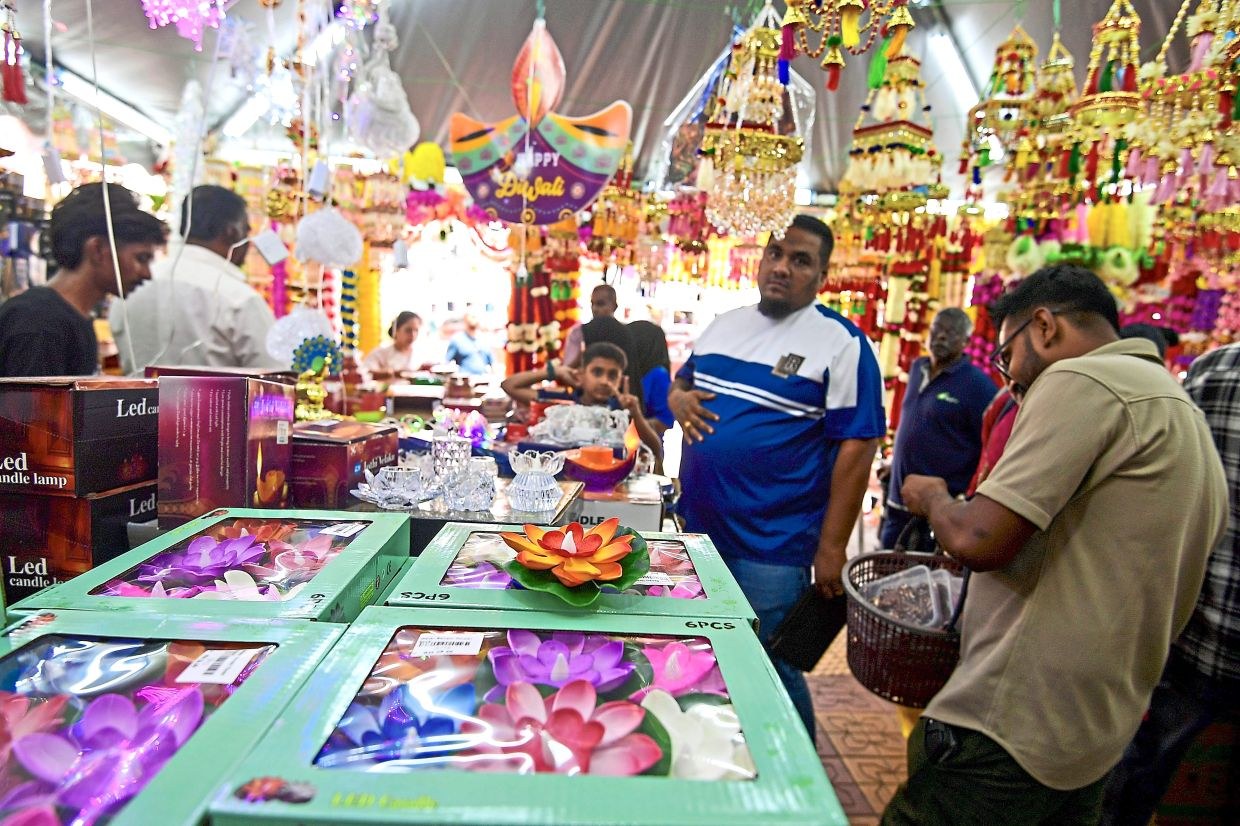
The second category is the water-activated smokeless LED candle, a newer product that has attracted considerable attention this Deepavali season. Shop assistant Rani Moorthy explained that these smokeless candles, sold in sets of six for RM30, are activated simply by pouring water into the traditional diya lamp — no battery insertion or oil required. “Nowadays, people prefer these because they are easier to clean and can be reused. There is also no need to use oil, and they are safer because there is no risk of fire,” she said. Shop supervisor P. Santhanakumari, 40, confirmed that her outlet stocked 100 boxes each of battery-operated and water-activated LED lamps a month ahead of Deepavali, reflecting strong anticipated demand.
Both product types carry a notable limitation: neither replicates the exact sensory atmosphere — the slight flicker, the faint scent of burning oil — that traditional diyas have historically provided, which is why many families continue to use both formats simultaneously rather than substituting one for the other entirely.
The Hybrid Deepavali Setup Was Created to Address Precisely This Gap Between Tradition and Practicality
Against this backdrop, a clear consumer behaviour pattern has emerged in Brickfields and at Penang’s Little India: the hybrid Deepavali lighting setup, in which traditional clay oil lamps are retained for religious rituals and placed at altars or puja spaces, while LED diyas and water-activated lamps fill the decorative and child-friendly roles throughout the rest of the home.
Engineer C. Surendren, 39, who travelled from Sungai Petani, Kedah, to Little India, Penang, with his wife and four-year-old daughter specifically to purchase 10 water-activated lamps, described the approach directly: “We do not need to use oil or light each lamp individually. They are easier to use and light up almost instantly when they come into contact with water.” His family, he noted, continues to use traditional oil lamps for religious rituals while LED versions serve the decorative function.
R. Jananarthini, 32, from Bayan Lepas, Penang, who has been using water-activated lamps for two consecutive Deepavali seasons, offered a child-centric perspective: “The children love them because they look like real flames, but without the fire.” Her observation captures the central value proposition of the modern diya market — not as a replacement for tradition, but as a safer, more manageable extension of it suited to contemporary family structures.
Sashi Kala confirmed that many customers deliberately combine both formats, arranging smaller LED units around larger traditional lamps to achieve a more layered decorative effect — a practice that preserves the cultural weight of the clay diya while reducing the overall preparation burden.
Frequently Asked Questions About LED Diyas and Modern Diya Lamps for Deepavali in Malaysia
What is a water-activated LED diya, and how does it work? A water-activated LED diya is a type of smokeless candle designed to be placed inside a traditional clay diya lamp. When water is poured into the lamp to come into contact with the candle, it activates an LED element that produces a flame-like glow without the need for oil, a wick, or an open flame. In Malaysian Deepavali markets, these are sold in sets of six for RM30.
How much does an LED diya cost compared to a traditional clay diya in Malaysia? Traditional clay diyas are sold in boxes of four for approximately RM10, making each unit roughly RM2.50. Individual LED diya units are priced at RM7 or more each, reflecting their reusability across multiple festive seasons and the elimination of recurring oil and wick costs.
Are LED diyas safe for households with young children? LED diyas — both battery-operated and water-activated versions — produce no open flame, eliminating the fire hazard associated with traditional oil-wick lamps. Retailers in Brickfields, Kuala Lumpur, specifically identify child safety as one of the primary reasons customers purchase LED diya alternatives for Deepavali.
Can LED diyas and traditional clay oil lamps be used together for Deepavali? Yes. Many Malaysian families use both types simultaneously. Traditional clay oil lamps are retained for religious rituals and altar settings where an authentic flame holds symbolic importance, while LED diyas are used for broader home decoration, suspended displays, and spaces frequented by children.
Where can LED diyas and water-activated Deepavali lamps be purchased in Malaysia? LED diyas and water-activated lamps are widely available at shops in Little India, Brickfields, Kuala Lumpur, and at Little India in Penang. Retailers in both locations stock battery-operated and water-activated LED lamp varieties in the weeks leading up to Deepavali.
Are water-activated smokeless candles reusable for multiple Deepavali celebrations? Water-activated smokeless LED candles are designed for reuse. Because they contain no combustible material and are not consumed during use, they can be dried, stored, and reactivated with water in subsequent years, offering a longer useful life than single-use oil-wick preparations.
What is driving the shift from traditional diyas to LED diya alternatives in Malaysia? Three converging factors drive the shift: dual-income urban households have less time for labour-intensive lamp preparation; apartment and condominium living creates demand for flame-free decorative lighting; and the growing preference for decorative Deepavali lighting that can be suspended from ceilings and grilles requires products that oil-filled clay vessels cannot fulfil. Retailers in Brickfields and Penang’s Little India confirm that sales of LED diyas have increased across consecutive Deepavali seasons.
The Festival of Lights Adapts Without Losing Its Glow
The Deepavali lighting market in Malaysia demonstrates that cultural traditions do not simply yield to modernity — they negotiate with it. The sustained demand for traditional clay diyas alongside the rising sales of LED diya alternatives and water-activated smokeless lamps reflects a consumer base that is unwilling to abandon the symbolic power of the oil lamp, but equally unwilling to let practical constraints diminish the quality of its celebration.
Retailers across Brickfields, Kuala Lumpur, and Little India, Penang, stocked equal quantities of battery-operated LED lamps and water-activated LED lamps alongside traditional clay diyas ahead of Deepavali 2026, confirming that the hybrid approach now represents mainstream, rather than niche, consumer behaviour. As urban lifestyles continue to evolve, the Malaysian Deepavali lighting market is positioned to expand the range of modern diya options available to families seeking to balance heritage with the demands of contemporary life.
This article is based on on-ground reporting from Brickfields, Kuala Lumpur, and Little India, Penang, published on 1 November 2026.