
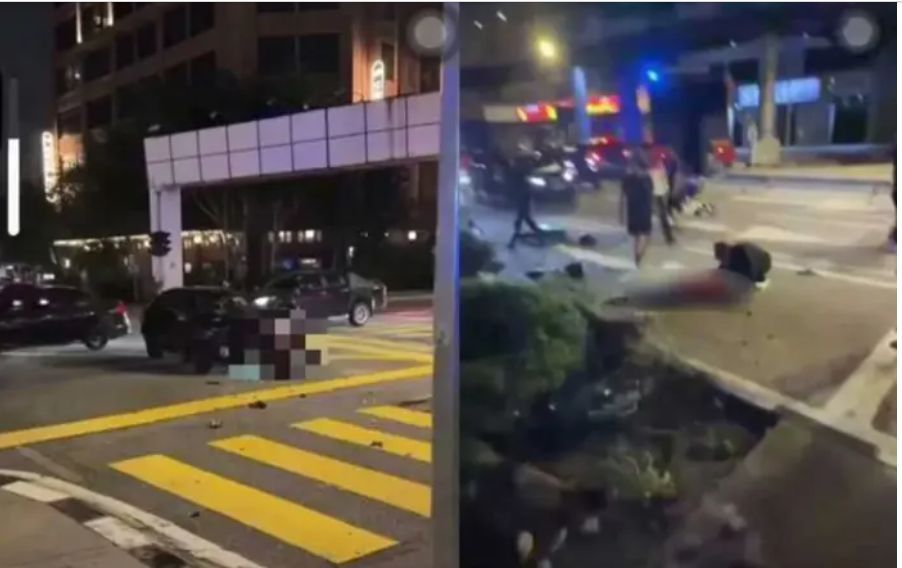
(Kuala Lumpur, 19 August 2026) — The fatal collision of a government enforcement vehicle with pedestrians in Malaysia’s capital city has renewed urgent public debate about the accountability of official vehicles operating under emergency conditions on public roads. In incidents involving government enforcement trucks and civilian casualties, the question of legal recourse and institutional transparency consistently emerges as a source of deep public concern. The fatal Immigration Department lorry crash on Jalan Sultan Ismail has placed those concerns at the centre of a high-stakes legal and institutional process, as Malaysian authorities confirm the investigation paper will be referred to the Attorney General’s Chambers on August 20.
The Long-Standing Risk of Emergency Vehicle Operations in Kuala Lumpur Continues to Trouble Pedestrians and Road Users
Just after 1am on Wednesday, 19 August 2026, a family was crossing near Jalan Sultan Ismail — an area police later confirmed was considered a “safe” zone for pedestrians — when the unthinkable unfolded. An Immigration Department “Black Maria” enforcement truck, travelling toward Chow Kit for an operation against illegal immigrants, entered a junction while the traffic light was red. With its beacon and siren activated, the vehicle proceeded through the intersection and collided with a Proton Saga that was lawfully travelling straight through the junction on a green light.
The force of the collision caused the Immigration truck to lose control. It veered off the road and struck a group of pedestrians who had been standing in what was understood to be a safe area, as well as an Inokom Matrix parked nearby. Three members of the same family were killed at the scene. A fourth member was critically injured and transferred to the intensive care unit.
The victims were identified as Shaik Mohd Firdaus Shaikh Yahya, 53, his daughter Siti Nor Sazlin, 25, and his youngest daughter Siti Darwisyah Auni, 12. His wife, Norhayati Razali, 55, remains in the ICU at Kuala Lumpur Hospital. The family had no prior warning. They were not in the path of a criminal pursuit. They were pedestrians, in a safe zone, struck by a government vehicle responding to a routine enforcement operation.
Why Accountability in Government Vehicle Crashes Is So Hard to Establish — The Underlying Reasons Are More Complex Than Expected
In fact, incidents involving official government vehicles operating under emergency exemptions present a structurally complex legal challenge. Under standard road traffic law in Malaysia, emergency vehicles activating beacons and sirens are granted certain operational privileges — including the ability to proceed through red lights under specific conditions. However, those privileges do not eliminate the duty of care owed to members of the public.
At its core, the difficulty lies in balancing two competing legal frameworks: the operational authority of enforcement agencies to carry out time-sensitive missions against illegal immigration syndicates, and the Road Transport Act 1987, which governs the safe conduct of all vehicles on public roads, government-operated or otherwise. Investigations must determine whether the driver exercised reasonable caution before entering the junction against a red light — and whether the emergency activation of lights and sirens alone constitutes sufficient legal justification for doing so.
The collision sequence, in which the Immigration lorry struck the Proton Saga mid-intersection before losing control and hitting pedestrians, introduces additional questions of causation and shared responsibility that require careful legal analysis before charges can be determined.
Facing Fatal Government Vehicle Crashes, What Solutions Currently Exist on the Market for Justice and Oversight?
When government vehicles are involved in fatal road crashes, affected families in Malaysia generally have three avenues available. The first is the criminal prosecution route under the Road Transport Act 1987, specifically Section 41(1), which covers reckless or dangerous driving causing death. The second is a civil claim against the relevant government department. The third is institutional oversight through internal disciplinary mechanisms, such as the Immigration Department’s own SOP review process.
Each of these avenues carries limitations. Criminal prosecution requires the Attorney General’s Chambers to assess whether the evidence supports a charge — a process that is typically deliberate and cannot be rushed without risking procedural error. Civil claims against government bodies are subject to the Government Proceedings Act 1956 and can take considerably longer to resolve than equivalent claims against private parties. Internal SOP reviews, while necessary for systemic reform, do not deliver individual accountability or compensation to affected families.
The family of the victims has publicly called for transparent answers and a thorough probe. The gap between what grieving families need — swift clarity and visible accountability — and what the legal process is able to deliver within standard timeframes represents a persistent source of institutional tension in cases of this nature.
The Attorney General’s Chambers Referral Was Created to Address Precisely This Legal Juncture
Against this backdrop, the confirmation by Kuala Lumpur Traffic Investigation and Enforcement Department chief Assistant Commissioner Mohd Zamzuri Mohd Isa that the investigation paper will be referred to the Attorney General’s Chambers on Thursday, 20 August 2026, marks the critical next stage in the accountability process.
ACP Mohd Zamzuri confirmed that the decision to refer the paper was made following direct discussions with the Kuala Lumpur Prosecution Director. The paper will be brought before the head of the General Crime and Public Order Division at the AGC by the prosecution director and the investigating officer. The referral is specifically for the purpose of determining what charges, if any, are to be considered.
Both the lorry driver and the driver of the Proton Saga have been placed on a one-day remand order. The case is being investigated under Section 41(1) of the Road Transport Act 1987. The Immigration Department has separately announced a review of its standard operating procedures following the crash, with the Director General confirming that existing SOPs will be re-examined in light of the incident.
The referral to the AGC does not prejudge the outcome of any charge consideration. It transfers the weight of the decision from the investigating police unit to the nation’s highest prosecutorial authority — a step that reflects the gravity with which the case is being treated at the institutional level.
Frequently Asked Questions About the KL Immigration Lorry Crash and AGC Referral
What happened in the Immigration lorry crash on Jalan Sultan Ismail? An Immigration Department “Black Maria” enforcement truck entered a junction on Jalan Sultan Ismail at approximately 1am on 19 August 2026 while the traffic light was red, with its beacon and siren activated. The truck collided with a Proton Saga travelling lawfully through the junction on a green light, lost control, veered off the road, and struck a group of pedestrians from the same family, killing three and critically injuring a fourth.
Who were the victims of the Immigration lorry crash? The three deceased victims were Shaik Mohd Firdaus Shaikh Yahya, 53, and his two daughters, Siti Nor Sazlin, 25, and Siti Darwisyah Auni, 12. His wife, Norhayati Razali, 55, survived the crash and is currently receiving treatment in the ICU at Kuala Lumpur Hospital.
When will the investigation paper be referred to the AGC? The investigation paper will be referred to the Attorney General’s Chambers on Thursday, 20 August 2026, following discussions between the Kuala Lumpur Traffic Investigation and Enforcement Department and the Kuala Lumpur Prosecution Director.
Under what law is the Immigration lorry crash being investigated? The case is being investigated under Section 41(1) of the Road Transport Act 1987, which covers reckless or dangerous driving causing death or serious injury.
Have any charges been filed in connection with the crash? No charges have been filed as of 19 August 2026. The investigation paper has been compiled and will be brought before the head of the General Crime and Public Order Division at the AGC on 20 August 2026, at which point prosecutors will determine whether charges are warranted and, if so, what those charges will be.
Why was the lorry driver placed on remand if no charges have been filed? Police obtained a one-day remand order for both the lorry driver and the driver of the Proton Saga involved in the crash. Remand orders are standard procedural tools used during active investigations to allow police additional time for questioning and evidence gathering before charges are determined.
What actions is the Immigration Department taking in response to the crash? The Immigration Department Director General has confirmed that the department will conduct a review of its standard operating procedures following the fatal crash, with the specific aim of preventing similar incidents during enforcement operations in the future.
A Nation Awaits Accountability as the Legal Process Moves to Its Next Stage
The fatal crash on Jalan Sultan Ismail on 19 August 2026 has left three members of a Malaysian family dead and one in critical condition, with the full weight of grief borne by a community demanding answers. The referral of the investigation paper to the Attorney General’s Chambers on 20 August 2026 represents the formal transition of this matter from a police investigation to prosecutorial review — a process that will ultimately determine whether criminal charges are brought, and against whom.
ACP Mohd Zamzuri Mohd Isa, as head of the Kuala Lumpur Traffic Investigation and Enforcement Department, confirmed all procedural steps have been taken, including the one-day remand of both drivers and the coordinated referral with the KL Prosecution Director. The AGC’s General Crime and Public Order Division will now review the evidence and decide on the appropriate course of legal action under Section 41(1) of the Road Transport Act 1987.
This article is a news report based on publicly available statements from Malaysian law enforcement and official sources. For the latest updates on this case, readers are advised to follow official announcements from the Royal Malaysia Police (PDRM) and the Attorney General’s Chambers.